
The Postcards That Saved A Town
How one restaurant owner’s old-fashioned reservation system kept her hometown post office alive

Hey, my friend,
I had to check this story for authenticity, but it’s absolutely true: postcards—plain old postcards—actually saved a post office.
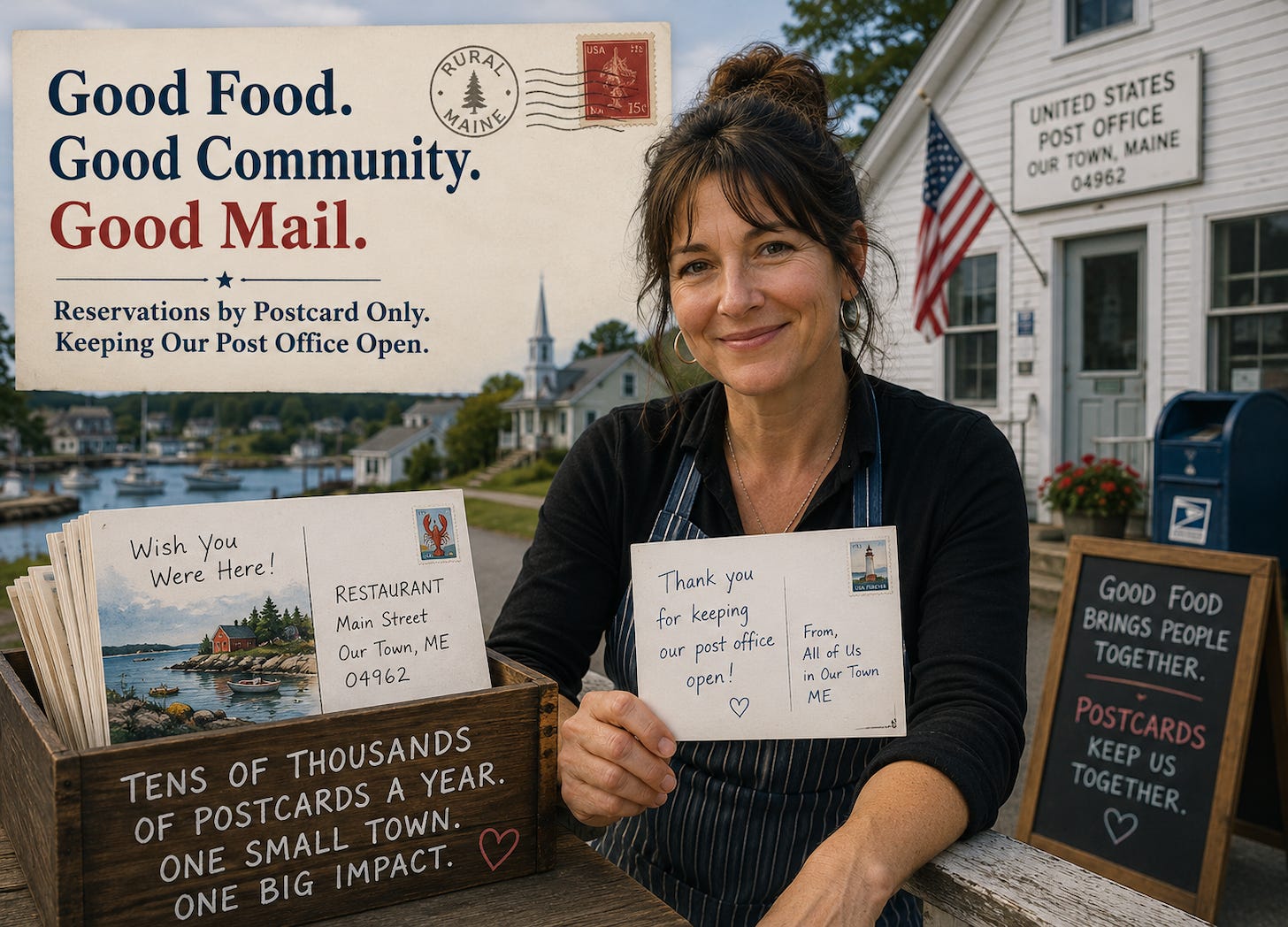
It wasn’t from a petition or a government bailout. Just tens of thousands of handwritten postcards, mailed from every corner of the world, all landing in the tiny post office of Freedom, Maine—population 719.
This is the story of The Lost Kitchen, and it’s one of my favorite examples of what happens when someone chooses pen and paper over the easy digital route.
The backstory
Chef Erin French opened The Lost Kitchen in 2014 inside a restored 1834 gristmill in her hometown of Freedom, Maine. It’s a 50-seat farm-to-table restaurant that serves dinner just a few nights a week, May through October. There are no professionally trained chefs on staff—just a team of women who cook with heart, grow the flowers for the tables, and raise the chickens served at dinner.
Word spread fast. By 2017, the restaurant was fielding 10,000 phone calls in a single week when reservations opened each Spring. They were overwhelmed.
Most restaurant owners in that position would have moved to an online booking platform—something efficient and modern.
Erin French went the other direction entirely.
Postcards only, please…
Starting in 2018, The Lost Kitchen stopped taking reservations by phone or online. Instead, if you want a seat at the table, you mail a postcard. That’s it. You write your name, contact information, and whatever else you’d like to share, and you mail it.
Erin and her team read them all, then draw names at random. If your card is pulled, you get a phone call to arrange your dinner date. If it’s not, your name goes onto the waitlist in case of cancellations.
The restaurant now receives upwards of 65,000 postcards a year. They arrive from every state and countries as far away as Malaysia and Hong Kong.
And then there’s the post office
Here’s the part that made me so happy.
Freedom’s post office—a small-town branch serving fewer than 750 residents—had been struggling. There were real concerns it might close.
Then the postcards started arriving. Tens of thousands of them, every Spring.
The flood of mail didn’t just keep the post office busy—it made it a destination. Visitors now stop by to take photos of the building. Restaurant staff have brought muffins to the postal workers. A retail associate at the Freedom Post Office has even been invited to draw a winning postcard.
The postcards saved the post office. And in doing so, they became part of the fabric of this tiny town.
Why this matters to the Heartspoken Movement
In a world that keeps pushing us toward faster, easier, more automated communication, Erin French made a deliberate choice to slow things down. She chose the handwritten over the typed, the stamped over the clicked.
And people didn’t resist. They loved it. They poured their hearts onto postcards with hand-painted watercolors, family recipes, poems, and personal stories, turning each postcard into a small canvas.
TIME magazine named The Lost Kitchen one of the world’s greatest places. Bloomberg called it one of 12 restaurants worth traveling around the world to experience. But to me, the most extraordinary thing about The Lost Kitchen isn’t the food—it’s that its chef in rural Maine proved what we already know in our bones:
Putting pen to paper still matters. And sometimes, it can save more than you expect.
Your Heartspoken Challenge this week
Send a postcard.
Not to The Lost Kitchen (though you certainly can!), but to someone who would never expect to receive one. A friend. A neighbor. A former colleague. A family member in another state.
Pick a postcard you love—or make one—and write something from the heart. It doesn’t need to be long. It just needs to be real.
You never know what it might save.
Thanks to my eagle-eyed sister, Sarah, who knew I’d love the story, here it is from Isaac French’s YouTube channel.
Know someone who lights up when they open their mailbox and find something handwritten? Share this story with them—they'll love it.
This week’s sample notes
Personal connection note
I received this note out of the blue from a highschool classmate.
I love keeping in touch with you via Facebook and your lovely newsletter. Call me if you come my way so we can have lunch. I know your parents and ancestors would be very proud of the woman you are and the ways you inspire others. Wishing you the very best in the coming year.
Why it works: Coming as a surprise from someone who has known me and my family for decades, this note truly touched my heart. The mention of parents and ancestors shows a depth of shared history that only a longtime connection can carry—and it transforms a simple "keep in touch" message into something profoundly meaningful.
Professional connection note
Note I sent when I was bank Board Chair to an executive administrative assistant who had coordinated two big events for our bank:
Great job on BOTH the annual shareholders meeting yesterday and the Bloom Party two weeks ago. Your hard work and thoughtful planning always seem effortless, but I know better! What you do makes us all look good.
Why it works: This note succeeds because it names both events specifically and then acknowledges the invisible labor behind work that "seems effortless. That combination of specificity and seeing-behind-the-curtain is more likely to make the recipient feel truly noticed, not just generically thanked.
Always remember
Whether written or spoken, words from the heart will never fail you!
See you next week!
Heartspokenly,

P.S. In case you missed these posts from last year “Postcards: Little Hugs by Mail” and “Postcrossing: Send a Card, See the World.”
A fabulous story. I will send a post card today. And I live in Maine so maybe I will drive by and check out Freedom.
Such a delightful story!