
Zip Code Confidential
Five digits, one very ignored genius, and a lot of mail

Hey, my friend,
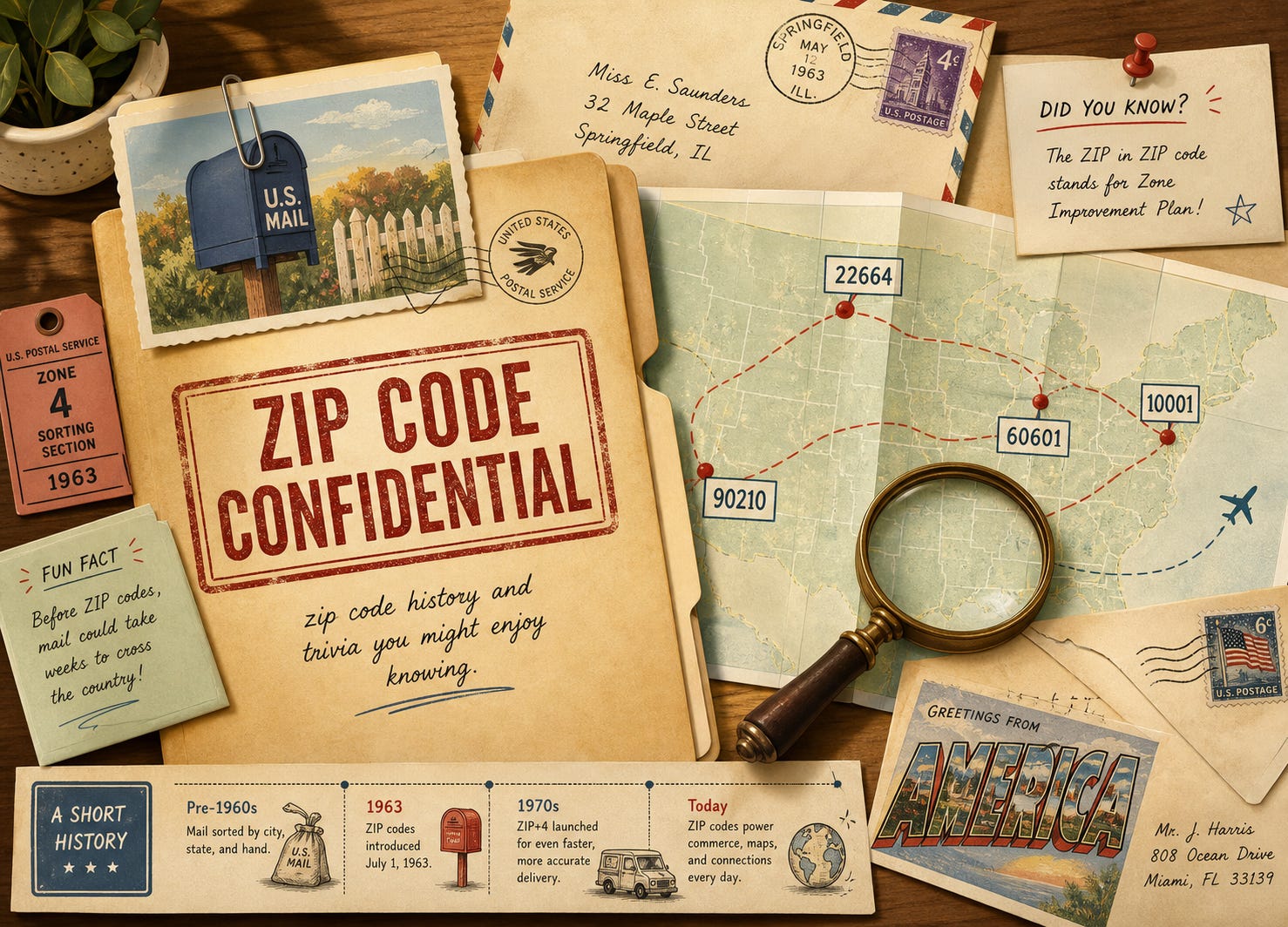
Tomorrow, July 1, is Zip Code Day!
You’ve written your ZIP code roughly ten thousand times in your life…on envelopes, online checkouts, warranty cards, sweepstakes entries. You write it without thinking. I wrote it several times just today.
Did you know it almost didn’t exist? And that one guy spent twenty years being completely ignored before it did?
Buckle up. I’m going full postal nerd today.
The Guy Nobody Listened To
His name was Robert Moon. Postal inspector. Visionary.
In 1944, Moon proposed a numerical grid system for routing mail—basically, dividing the whole country into zones so letters could be sorted by number instead of by a postal worker’s memory. He figured airplanes were going to replace trains for mail transport, and speed was going to matter.
He was right, but the postal service did nothing with his idea for nineteen years.
Finally, in July 1963, they launched the Zone Improvement Plan—ZIP—based on Moon’s original concept, so he is considered the father of the ZIP code.
The mail was delivered much faster, so everybody won, eventually, but I remember my parents grumbling about the inconvenience of having to add those five numbers to every letter.
What You’re Actually Writing
Here’s the part that genuinely delighted me. Those five digits aren’t random. They’re a map.
The first digit points to a broad region—from 0 in the East to 9 in the West. The next two digits narrow the mail to a regional area, and the final two identify the local post office. So every time you write a ZIP Code, you’re drawing a path from the whole country down to one specific spot on the map.
Before this system existed, mail was sorted by postal workers who had to recognize towns and streets from memory. After World War II, when the population exploded and everyone started moving everywhere, that method collapsed under the weight of it all.
The ZIP code didn’t just speed things up. It saved the whole operation.
The Four Extra Digits Nobody Asked For
In 1983, the U.S. Postal Service decided five digits weren’t enough and introduced the ZIP+4 to make a total of nine digits, with a hyphen in the middle. You’ve seen it. You’ve probably ignored it.
For personal mail, you’re fine ignoring the Zip+4. Your five-digit ZIP will get your letter where it’s going.
Believe it or not, those four extra digits can help businesses figure out sales tax to charge an online customer. A single five-digit ZIP Code can spill across county lines, city limits, or special tax districts. The ZIP+4 helps sellers land on the right rate. So even if you never bother writing those extra digits yourself, they may still be working behind the scenes when a package is headed your way.
The ZIP Codes That Became Famous
Some ZIP codes have taken on a life of their own. Here are a few of my favorites:
90210—Beverly Hills, California. Thanks to a 1990s TV drama, this is arguably the most recognizable ZIP code on earth. Rodeo Drive, mansions, and a particular kind of California mythology. The show ended. The ZIP code’s fame did not.
12345—Schenectady, New York. This is the ZIP code for the General Electric campus, and it’s the most sequential ZIP in the country. Every year, thousands of children write letters addressed to “Santa Claus, 12345” because they’re convinced that’s where he lives. GE employees have been sorting Christmas mail for decades. Nobody has the heart to stop them.
20252—Washington, D.C. Smokey Bear received so much fan mail from children applying to be Junior Forest Rangers that the U.S. Postal Service gave him his own dedicated ZIP code. Fully operational since 1964.**
48222—Detroit, Michigan. The only floating ZIP code in the United States, assigned to the J.W. Westcott II—a boat that delivers mail to cargo ships passing through the Detroit River without them ever having to dock. Your mail carrier drives a truck. This one drives a boat.
42748—Hodgenville, Kentucky. The birthplace of Abraham Lincoln. Five digits and the full weight of American history.
Thank you, Robert Moon
There are more than 41,000 ZIP codes in the United States. Every single one is doing Robert Moon’s work behind the scenes—moving words and parcels and birthday cards across this enormous country of ours.
The man waited nineteen years for someone to use his idea. Seems like the least we can do is know his name.
Coming up
Next week starts my three-week exploration of some remarkable correspondence from America’s founding era—letters from the likes of Abigail Adams, Benjamin Frankin, and Thomas Jefferson.
These letters reveal so much about the lives of both Patriots and Loyalists—and about what it means to put something you believe on paper and sign your name.
Don’t miss this series.
Always remember
Whether written or spoken, words from the heart will never fail you!
Heartspokenly,

P.S. In case you, too, want to go full postal nerd, the USPS has a free ZIP code lookup tool that I use all the time at usps.com that will give you several ways to find a zip code—including that elusive ZIP+4.
**CORRECTION: In my original post, I referred to Smokey Bear as a fictional bear. An eagle-eyed reader in New Mexiso (my daughter), made sure I got my facts straight:
“Hi! Smokey Bear was a real bear cub rescued after a 1950 wildfire in New Mexico! The NM State Forester brought him to Santa Fe, and our neighborhood story is that Smokey was temporarily housed in a shed next door to our house that doesnt exist anymore while he was treated for burns. He lived out his life at the National Zoo in DC. He is buried at the Smokey Bear Historical Park in Capitan, NM which is run by...EMNRD State Forestry Division!”

Questions and Answers about this post (FAQ)
If I am a contemporary note or letter writer, how does this article inform, inspire, enrich, or improve my own written correspondence practice?
It restores meaning to a step most of us do on autopilot. Those five digits you write on every envelope are a map—region, sorting hub, local post office—connecting your words to one specific person across a network of more than 41,000 ZIP codes. Knowing the system makes addressing an envelope feel like participation rather than routine. Robert Moon’s story also offers a writing prompt for both personal and professional correspondents: he waited nineteen years for recognition, and someone in your life or your organization is waiting too. A short note of appreciation is the remedy within your reach. And if you want to go full postal nerd, the free USPS lookup tool at usps.com will tell you your own ZIP+4. NOTE: at this time, the ZIP+4 is not needed on personal mail, but I include it in my address book whenever I know what it is.
Who invented the ZIP code?
Robert Moon, a postal inspector, proposed a numerical grid system for routing mail in 1944. The postal service set his idea aside for nineteen years before launching the Zone Improvement Plan (ZIP) in July 1963, using Moon’s original three-digit concept plus two additional digits contributed by other postal officials. Moon is credited as the father of the ZIP code.
What do the five digits in a ZIP code mean?
They’re a map. The first digit identifies your region of the country—0 for the Northeast through 9 for the West. The next two digits route mail to a regional sorting hub, and the final two direct it to your local post office.
What does ZIP stand for in ZIP code?
Zone Improvement Plan, the system the U.S. Postal Service launched in July 1963.
Do I need to use the ZIP+4 on my letters?
For personal mail, no—your five-digit ZIP code will get your letter where it’s going. Businesses use the four extra digits, introduced in 1983, to calculate sales tax, since a single five-digit ZIP can overlap multiple tax jurisdictions: different counties, cities, and special tax districts.
Why do children send Santa letters to ZIP code 12345?
A: 12345 belongs to the General Electric campus in Schenectady, New York, and it’s the most sequential ZIP code in the country. Every year, thousands of children write to “Santa Claus, 12345” convinced that’s where he lives, and GE employees have sorted the Christmas mail for decades.
What is the only floating ZIP code in the United States?
48222, assigned to the J.W. Westcott II—a boat that delivers mail to cargo ships passing through the Detroit River without their having to dock.
When did ZIP codes start in the United States?
July 1963, when the postal service launched the Zone Improvement Plan. The ZIP+4 followed twenty years later, in 1983.
This was such a fun and informative peek behind the scenes of the ZIP code system, Elizabeth. I'm fascinated by the famous ZIP codes you mentioned. If I can add one more, The Empire State Building has its own ZIP code, 10118, due to its massive size and the high volume of mail it receives. Thanks for another great newsletter!
Fascinating information that I didn’t even know I was missing … and I will never look at zip codes the same! Thanks Elizabeth. 🙏 Always learn from you while being inspired to keep writing letters (one of my favorite things to write, from the heart & unedited).