
The Return of Cursive
And why it never should have left…

Hey, my friend,
First of all, thank you to so many who reached out to check on me after reading about my fall in last week’s post (“Life Can Turn On A Dime”). I’m feeling better every day but still taking it easy.
There’s a good chance you’ve never stopped writing in cursive. Maybe you reach for it when you sign a birthday card, address an envelope, or settle in to write a real letter—the kind that takes a little time and means it. If so, you’ve been doing something the rest of the world is just now remembering matters.
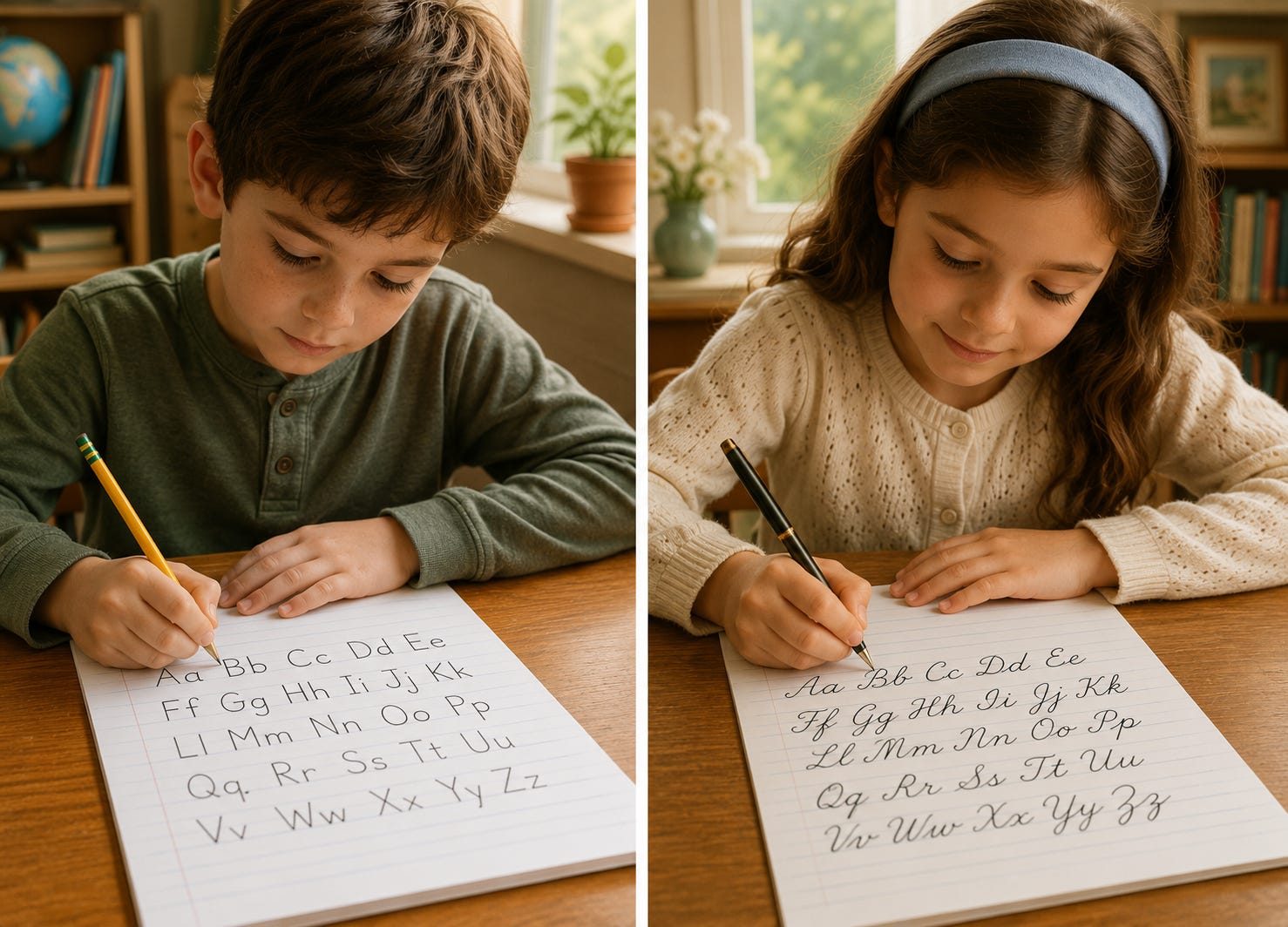
Cursive is coming back in American classrooms.
As of this year, 27 states have passed laws requiring it to be taught in public schools—up from just 14 states a decade ago. New Jersey and Pennsylvania both signed mandates into law in early 2026. The trend is moving in one direction only.
It wasn’t so long ago that cursive disappeared from classrooms almost overnight. When the Common Core standards were adopted in 2010, keyboarding was in and cursive was out. By 2012 or so, teachers who had once spent part of every school day on penmanship found it simply wasn’t in the curriculum anymore. A generation of students grew up without it.
The consequences were stranger than anyone anticipated.
Young people today often can’t read a grandparent’s letter. Historians and archivists have had to recruit volunteers who can still decipher cursive to help transcribe Revolutionary War-era documents—because the pool of people who can read America’s own handwritten history is shrinking. The National Archives has called the ability to read cursive “a superpower.”
That’s not hyperbole.
It’s a description of a skill that has become genuinely rare.
What the Science Is Saying
Here’s where it gets interesting.
Researchers have been studying what actually happens in the brain when we write by hand—and what they’re finding would not surprise anyone who has experienced the clarity that comes from putting pen to paper.
A 2024 study found that when people write by hand, the brain areas responsible for motor control, vision, and memory formation synchronize in ways that simply don’t happen when typing. The researchers could observe it on brain scans: a kind of whole-brain engagement that a keyboard never produces. Cursive in particular—with its flowing, connected strokes—activates patterns of neural activity associated with memory encoding and learning. Your brain, it turns out, is doing something meaningful when your hand forms those looping letters.
None of this will feel like news to you. The experience of writing something by hand—really writing it, not typing it—feels different because it is different. The science is just now catching up with what your hand already knew.
More Than Nostalgia
It would be easy to dismiss the cursive revival as nostalgia—a longing for a simpler time dressed up in education policy. I imagine there is some of that at work. But the arguments for bringing it back are more substantive than sentiment.
One Pennsylvania state senator put it this way when his state’s cursive bill was signed into law: reintegrating cursive into the curriculum “is not simply teaching handwriting—it is investing in our students’ cognitive development, strengthening their legal preparedness, and preserving their connection to historical literacy.”
That’s a lot to ask of a looping capital Q. But he’s not wrong.
There’s also something to be said for the act of slowing down. One middle school teacher, reflecting on the cursive mandate in his state, put it simply: the return of cursive “reflects a desire to help our students slow down, take their time, and take pride in their work.” In an era when everything defaults to fast, that’s not a small thing.
You already know this.
Every time you choose to write something by hand—a note tucked into a bag, a card left on a desk, a letter folded into an envelope—you are making a small act of resistance against the frictionless and the forgettable. You are giving someone something that took real time and real attention to make.
The classrooms are catching up. It’s a good sign.
I’d love to hear from you: do you still write in cursive? Was there a moment—a letter received, a note written—when you felt its particular power? Hit reply and tell me.
Always remember
Whether written or spoken, words from the heart will never fail you!
See you next week!
Heartspokenly,

SOURCES
Ackerman, Cory. “A Closer Look: The Mighty Power of Cursive Handwriting” History Associates, December 26, 2024. https://www.historyassociates.com/the-power-of-cursive/.
Baisas, Laura. “Know How to Read Cursive? The National Archives Wants You.” Popular Science, January 16, 2025. https://www.popsci.com/technology/cursive-national-archives/.
Baudot, Laurence. “When Children Learn Handwriting, They Learn to Connect.” The HEARTSPOKEN Note. July 8, 2025. https://heartspoken.substack.com/p/when-children-learn-handwriting-they.
Bergland, Christopher. “Why Cursive Handwriting Is Good for Your Brain.” Psychology Today, October 2, 2020. https://www.psychologytoday.com/us/blog/the-athletes-way/202010/why-cursive-handwriting-is-good-your-brain.
Fisher, Saundra. “Handwriting: Can It Save Us From Digital Frenzy?” The HEARTSPOKEN Note. June 17, 2025. https://heartspoken.com/p/handwriting-can-it-save-us-from-digital.
Lambert, Jonathan. “Why writing by hand beats typing for thinking and learning.” NPR Shots, May 11, 2024. https://www.npr.org/sections/health-shots/2024/05/11/1250529661/handwriting-cursive-typing-schools-learning-brain.
National Education Association. “Why Cursive is Back in the Classroom.” NEA Today, March 9, 2026. https://www.nea.org/nea-today/all-news-articles/why-cursive-back-classroom.
Neuroscience News. “Handwriting Boosts Brain Connectivity and Learning.” Neuroscience News, January 27, 2024. https://neurosciencenews.com/handwriting-learning-brain-connectivity-25522/.
Trethan, Phaedra. "Cursive Writing is Making a Big Comback: Here’s Why." USA Today, February 28, 2026 (Updated March 4, 2026). https://www.usatoday.com/story/news/nation/2026/02/28/is-cursive-still-taught-in-schools-trend/88827717007/.
When my nephew was in high school, I gave him a card with a congratulations note and money inside. He came to me and said, "Aunt Tess, I cannot read your note." 😪
I'm so glad to see a cursive revival!
I hope you’re recovering well 🤗I do still write in cursive, mostly for birthday cards and the odd proper letter, and there is a quiet steadiness in it that no keyboard has ever given me. The part about reading old family handwriting caught me, because my grandmother’s script is half the reason her letters still feel like her. Has your own handwriting changed much since the days you were first taught it at school?